For all it’s worth, Vikings is not the kind of show that you would expect to be particularly woke (Scandinavian warriors are often claimed in the so-called Aryan legacy of white supremacists), but there are aspects of the show that I nonetheless enjoy for their revisionism of historical narratives that insist on projecting contemporary conservative conceits about “the past”. Same-sex romance, a certain flexibility in gender roles, cultural and religious intermixing, class-crossing abound in Hirst’s show. In Kattegat, Lagertha rises from farmer to queen, as she manages to impose herself first as earl, and later as queen by slaying Aslaug, who had replaced her as the main concubine and ruler of the kingdom. She installs a matriarchal rule, even going as far as refusing to remarry and keeping a woman, Astrid, as her lover, as well as a personal guard and advisory committee of shield maidens, including Torvi, her daughter-in-law. From beginning to end of the show, we are made to side with Lagertha, shield maiden extraordinaire and consistent winner in the category of badassery.
That kind of characterization easily falls in line with the recent “feminist”-leaning trend to incorporate more sheroes into the Hollywood narrative (the fact that they have to be warriors is itself problematic and should be the subject of another post entirely – I’m looking at you, Wonder Woman, Daenerys et al.). Vikings also manages to escape its snow-white Scandinavia to portray a variety of other ethnic groups. Unfortunately, this attempt at diversity turns out to be awkward, if not highly problematic at times.
I was actually shocked by the gratuitous display of Orientalism of the episodes in Season 5 that follow Björn and his party’s foray into the Arab world. Orientalism is a concept coined by Edward Said in the eponymous influential 1978 book. In it, he explains how depictions of the Middle East by Western authors made a heavy use of negative clichés, one of them being the feminization of “Oriental” cultures as a whole and of men specifically. Despite their fascination for what they called “the Orient”, characterizing “Oriental” mores and people as inferior conveniently justified colonial domination. Throughout the show, it was disappointing to see how Vikings repeatedly dealt in a number of clichés when it came to depicting peoples other than the Norsemen (read, “non-Western” peoples). The Saxons, unsurprisingly, are spared the treatment, and are only mocked for their cluelessness during numerous battles against the brave and smart Vikings.
To diversify the storyline and showcase the fairly multicultural world in which the Vikings lived, “from Newfoundland to Baghdad“, Ragnar Lothbrok and other Vikings follow his dream to visit unknown lands. The Vikings’ encounters with other ethnic groups offer a bit of diversity and somewhat mitigate the myth of ethnic or cultural purity in the already globalizing world of the tenth century. The presence of interpreters, and some characters’ ability to speak other languages further support the idea of cross-cultural contact at the time, mainly through plunder, trade, and settlements, but also military alliances. At the beginning of Season 5, Queen Lagertha enlists the Sami, a separate ethnic group living North of Scandinavia, to help her defend Kattegat against an impeding invasion. Björn’s encounter with the Sami princess left me somewhat annoyed. Convinced that he would need to marry her first in order to get into her panties (Björn dumps his long time wife Torvi in the process), he goes to ask for her father’s approval, in good ol’ patriarchal fashion, but the two laugh it off and leave him puzzled. Little does he know: the princess promptly beckons him to her tent and proceeds to bind him up with a rope, informing him on her tribe’s custom in which women tie up the reindeer and chew their balls off, before she straddles him. Is Hirst implying that Samis practiced BDSM between the (fur) blankets? After their lust is consumed, the plot leaves the tryst at that, and I am left to wonder once again if the sexual encounter is just another gratuitous and somewhat random sex scene without much to advance the plot.
In retrospect, I chose to read it as yet another instance in the show where cultures other than Viking are presented as strange and deviant. Any encounter with a foreign (read, “exotic”) people is treated as an excuse to shock the viewer. This is made apparent specifically through sexual mores and practices. Perhaps the most outrageous example happens in episode 5, season 5. Stereotypes about the Arab world abound in the season and I couldn’t help but roll my eyes throughout it.
In Season 5, Björn, thirsty for world discovery and following in the footsteps of his father Ragnar, explores the Mediterranean and lands in Algeciras (a city in Southern Spain occupied by the Moors at the time) where he and his Viking party come upon a harem; we are made to understand that the intruders do what Vikings are expected to do (rape and pillage). The harem is already a huge red flag, highly symbolic in the Western imaginary of the Orient as a place of female sexual promiscuity but also submissiveness to the patriarch who kept the harem (not to mention the fact that the harem guardians were eunuchs, castrated men, thus feeding the trope of the feminization of “Oriental” men). Following the Orientalist logic, here the white, male invader subdues the Oriental feminine in the Oriental space par excellence, the harem.
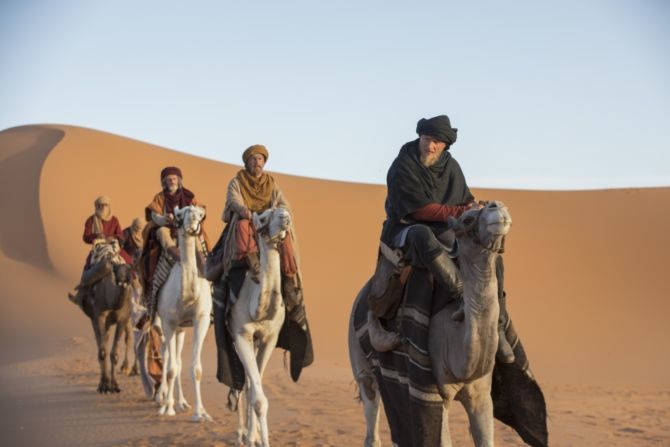
More adventures in this exotic world ensue, with its slew of clichés. Later as they land in Sicily, Björn and Halfdan are hired as personal bodyguards for commander Euphemius, a practice recorded among Byzantine emperors who, impressed by the Vikings’ combat technique, employed them as the elite “Varangian guard”. Trade with the Byzantine and Arab worlds was a known fact for the Rus, a Viking dominated multiethnic people of Eastern Europe (thanks National Geographic!). Björn and Halfdan in their capacity as bodyguards then end up in the Tunisian desert, which is part of a very loosely constructed plot – the mysterious and beautiful Kassia, a nun abducted by Euphemius, requests to go visit the emir Ziyadat Allah in Kairouan for some obscure reason. At this point, the Norsemen incursion to the most Southern point they have ever been seems to offer nothing but the sharpest of contrast and display of exoticism – sand desert and extreme heat, against their habitual snow and Northern landscapes. Throughout their stay in the Mediterranean, the Vikings are also warned multiple times by their interpreter that in this world, “nothing is as it seems”. The Arab world is, exactly as Said would define the views of Orientalism, strange, eroticized, and treacherous. Eventually, they manage to escape from being executed by the emir, despite the swords falling down on their necks (Arabs beheading people, sounds familiar, anyone?), as a sandstorm spirits them away at the last minute. This plot twist was indeed an easy way out of this nonsense for the screenwriters. In the next episode we learn that Björn and Halfdan somehow made it safely through the desert and sailed back to Kattegat. I am glad we are done with this baloney (for now).
“She was not a she” – Halfdan
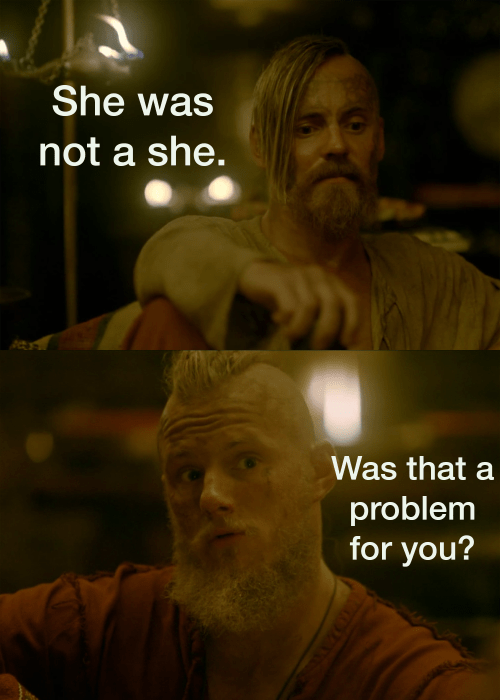
My main issue with the episode was the short comic scene when the two chums discuss how their night went. Bedecked in sumptuous silks and flowy pants by their new employer, Björn and Halfdan are offered prostitutes for an overnight entertainment (a diversion which will cost their boss his life – he will be served to them as cutlets for dinner, in case it wasn’t clear yet that the “Orientals” had curious mores). The morning after, Halfdan inquires from Björn about his night, and informs him that the woman who was given to him was, in fact, a man. Halfdan looks only slightly puzzled, but not that afflicted. As the hilarious sweatpantsandcoffee remarks, he “never answers Björn’s question” as to whether that bothered him. But why use the transgender prostitute in the plot here? One theory is that it introduces ambiguity about Halfdan’s sexuality; perhaps the emir meant to play a joke on Halfdan, having sensed his special relationship with Björn, and thus offered him a trans prostitute to mock (or please) him. There is definitely a sense that the pair love each other very much. How else do we account for Halfdan stubbornly siding with Björn against his own brother, Harald? But that question is actually beyond the point here. The situation itself is not historically inaccurate: there are records of transgender prostitutes in the Arab world since ancient times. But considering the amount of hackneyed clichés already used in the context, it’s hard not to read this as yet another instance of feminization (and literally, castration) of the Arab man.
As usual, the “Orient” (in this case, Arabia and the Byzantine empire) is represented as mysterious, and the episode illustrates the interpreter’s warning that “nothing is as it seems”, implying a treacherous environment. Orientals are once again depicted as inscrutable, even if highly refined in their manners, civilities, and sense of exquisite aesthetics. In contrast, the Vikings in the midst of their hosts seem brutish and uncivilized – but they remain readable, and most importantly, the “norm”. Commander Euphemius and the emir are two men of great beauty and with a sense of lavish hospitality towards their guests, and yet their actions look capricious at best, demented at worst (Euphemius lets out a hysterical laugh when Björn attacks him at first, and Ziyadat serves Euphemius’ body parts for dinner without any real explanation). But at least we’ve been spared the usual eyeliner that Hollywood loves to smear on their Oriental men and women (for some reason the show reserved that for Vikings to enhance their bluest eyes…).
Ragnar’s encounter in a previous season with the Chinese princess turned captured slave, Yidu, also exemplifies this Orientalizing tendency, especially as she becomes a sexual foil to distract Ragnar from his estranged wife Aslaug. Yidu also uses her personal stash of herbs to help Ragnar cope with the pain from his battle wounds, but he becomes addicted to them. This conveys the idea that the strange (or evil) Oriental lady is keeping Ragnar under her spell with sex and drugs, and recalls the hackneyed opium-smoking Chinese and dragon lady clichés. But that could be the subject of a whole other post as a perfect case study of Orientalism.
Now, I’m only waiting for the next season to take on the Vikings’ journey to Vinland, or America. Perhaps the screenwriters will play with chronology a bit and allow Ragnar’s descendants to land in America, about 500 years before Columbus did, as chronicled in The Saga of Eric the Red (the first exploration by Norsemen into Vinland dates circa 1000, whereas the action in Vikings seems to be taking place roughly around the 900). And I will be curious to see how they portray the native inhabitants that they encounter there…
Sources:
Klein, Christopher. “Globetrotting Vikings: to the Gates of Paris.” History.com, 22 Nov. 2016, http://www.history.com/news/globetrotting-vikings-to-the-gates-of-paris.
Pringle, Heather. “New Visions of the Vikings.” National Geographic, Mar. 2017, pp. 30–51.
Said, Edward. Orientalism. New York: Pantheon Books, 1978.

 Morgane Flahault